
Humanoid Robots: The Circus Act We Keep Mistaking for the Future
They strut, they flip, they fall like refrigerators and until they grow real hands, they’re more spectacle than solution.
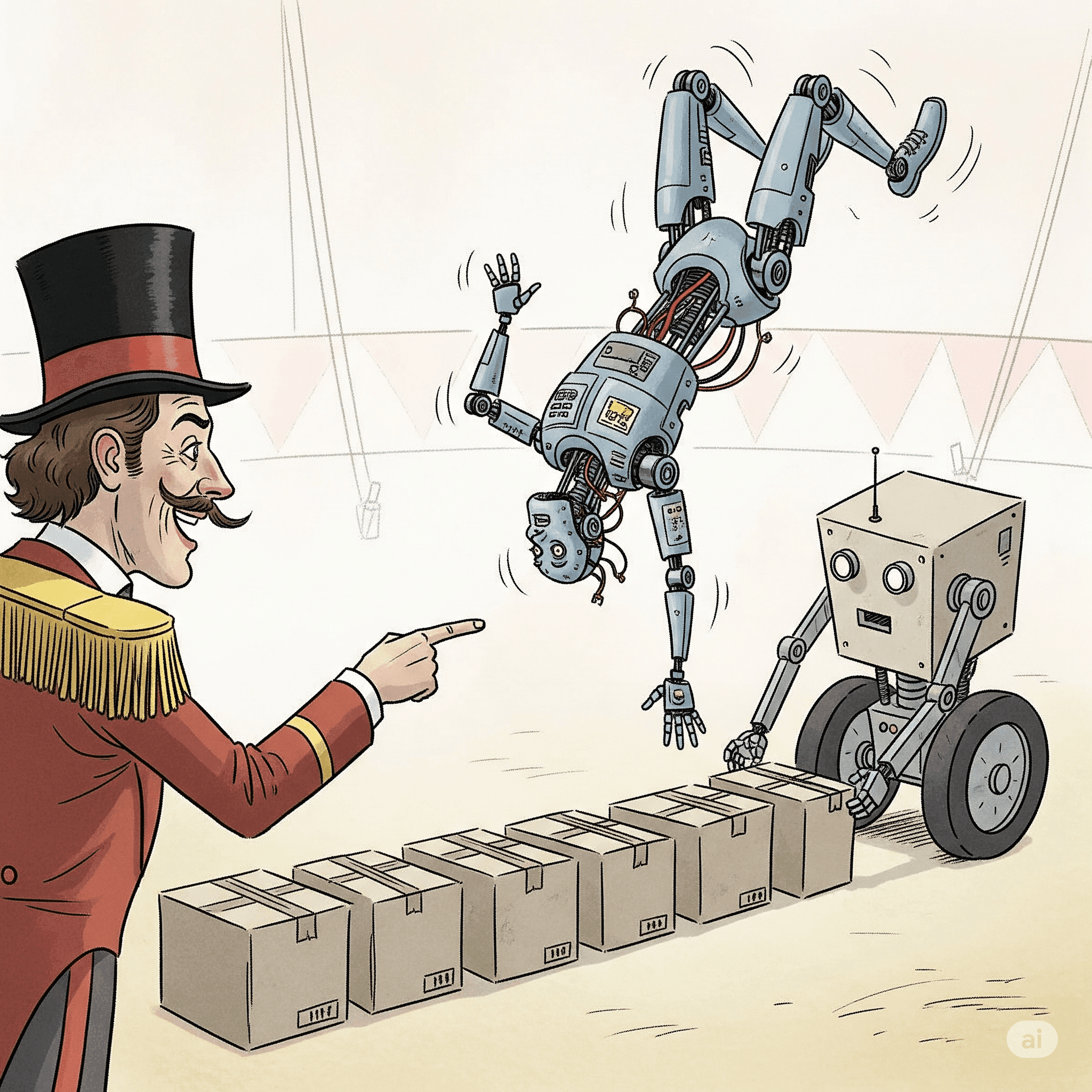
Humanoid robots are the Kardashians of robotics: constantly trending, endlessly photogenic, and just mysterious enough to keep us talking. They walk on stage, wave, maybe do a backflip if you’re lucky, and we can’t help but wonder: is this the future of work, or just an expensive TikTok stunt?
The dream is simple: build a robot that looks and moves like us so it can instantly plug into our world. No new factories, no new tools, no new infrastructure. Just drop a humanoid into your warehouse, hospital, or grandma’s living room, and voilà, automated labor.
But the humanoid form is both genius and madness. It’s genius because our world is literally designed around it. It’s madness because replicating it is like trying to re-engineer evolution’s greatest hack using motors, wires, and code. It’s the robotics equivalent of remaking “The Godfather” shot-for-shot with sock puppets: impressive if you pull it off, but do you really want to?
Let’s break down why humanoid robots are both the most exciting and the most overhyped machines in development today.
The Upside: Why We’re Obsessed
Robots, Welcome to Your Pre-Furnished Apartment Called Earth We’ve already spent millennia designing the world for humanoids. Handrails, door handles, stairs, forklifts, even Xbox controllers. A robot in the same shape can use them all. That means no billion-dollar retrofits of every warehouse and hospital. A humanoid can just walk in, grab the mop, and get to work. That’s a level of plug-and-play no wheeled cart or spider-bot can touch.
The Generalist Gamble: Why Buy an Army When You Can Have a Swiss Army Knife? Evolution made the human body a generalist machine: not the fastest, not the strongest, but adaptable enough to throw spears, play violins, and fix leaky sinks. Humanoid robots are an attempt to bottle that magic. This is the big bet: instead of buying an army of cheaper, more efficient single-task specialists (one for welding, one for lifting, one for making lattes), you invest in a single, general-purpose platform that can be retrained on demand with a software update. It's a bet on long-term flexibility over short-term, specialized efficiency.
Finally, a Coworker Who Understands Your Passive-Aggressive Nods Humans are terrible at learning new interfaces (raise your hand if you’ve rage-quit a printer setup). But put a robot in a familiar body and suddenly collaboration feels natural. A humanoid can point, gesture, nod, and make eye contact in ways that instantly map onto our social wiring.
The OSHA Violation You Can Replace The three Ds—dull, dirty, and dangerous—are basically what humanoids are born for. Send them into burning buildings, nuclear plants, disaster zones, or the monotony of factory shifts. Every workplace injury avoided is a win, and if a robot falls into a chemical vat, you don’t need to call HR, just a repair crew.
Meet Grandma’s 24/7 Spotter: “Because Nothing Says Love Like a Robot Nurse with Cold Hands” The world is getting older, and humans are in short supply(We could, of course, solve this with immigration, but in the West that idea is apparently scarier than an army of fridge-sized robots with salad-tongs for hands). Humanoid robots could literally pick up the slack, helping patients move, lifting heavy loads, monitoring vitals, or just keeping lonely seniors company. They’re not about to replace nurses or family, but they could extend the reach of human caregivers.
The Downside: Why We Should Be Skeptical
Ten Billion Dollars Later, Still Losing to a Toddler on a Perfectly Flat Floor Here’s the cruel irony: the thing toddlers master in a year, walking, remains one of the hardest problems in robotics. Balancing on two legs is an engineering migraine. And for the use cases we're shown right now, carrying totes across a polished warehouse floor, it’s just plain inefficient. A simple wheeled robot is faster, more stable, carries more weight, and uses less energy for that specific job. The whole argument for legs is a bet on handling the messy 10% of the world: the stairs, the stray cables, the clutter. But for the clean 90% where they're being demoed, it's like entering a Formula 1 car in a drag race; it looks cool, but it's the wrong tool for the job.
Warning: Falling Robot Has the Same Kinetic Energy as Your Car A humanoid isn’t just unstable; it’s tall and heavy. When it falls, it doesn’t topple like a chair; it crashes like a fridge full of bricks. That’s not just embarrassing, it’s a massive safety hazard.
The Smile That Will Haunt Your Dreams: The Uncanny Valley Problem Make a robot too human-like and people get creeped out. Too realistic, and it’s unsettling. Too mechanical, and it’s alien. It’s a lose-lose balancing act that only humanoid robots face, ensuring they'll always be just a little bit weird.
Why Stop at Our Strengths When You Can Copy Our Flaws Too? Let’s be honest: the human body isn’t perfect. Bad backs, fragile knees, limited strength, awkward ergonomics, we’re a bundle of evolutionary compromises. By copying this form, we are intentionally building these biological limitations and vulnerabilities into our machines. It’s a bold strategy to prioritize a familiar shape over a potentially superior, purpose-built design.
They Can Dance, But Can’t Screw In a Lightbulb And here’s the killer flaw that makes everything else a potential gimmick: hands. Locomotion is flashy, but manipulation is where the money is. Walking to a shelf is a solved problem; picking the right screw out of a parts bin is the final boss of robotics. Until humanoids master dexterity, multi-fingered, sensor-rich, human-grade manipulation, they’re little more than expensive stunt performers. The vast majority of useful work involves the hands, and without them, a humanoid is a technological spectacle, a solution in search of a problem.
The Verdict: Spectacle vs. Substance
Humanoid robots are the moonshot of robotics. They grab headlines, inspire funding, and push the boundaries of what’s possible. But they also risk becoming a spectacle, machines built to impress investors and audiences more than to solve real problems.
The truth is messy: humanoids are both inevitable and impractical. Inevitable, because the allure of human-shaped machines is too strong to resist. Impractical, because for many of today's problems, a cheaper, simpler robot will quietly outcompete them.
The deciding factor will be hands, not legs. Walking is show business; manipulation is the real business. If humanoid robots can close the dexterity gap, they might just graduate from viral demos to actual workers. If not, they’ll remain the circus act of robotics, fun to watch, but not the ones doing the heavy lifting.